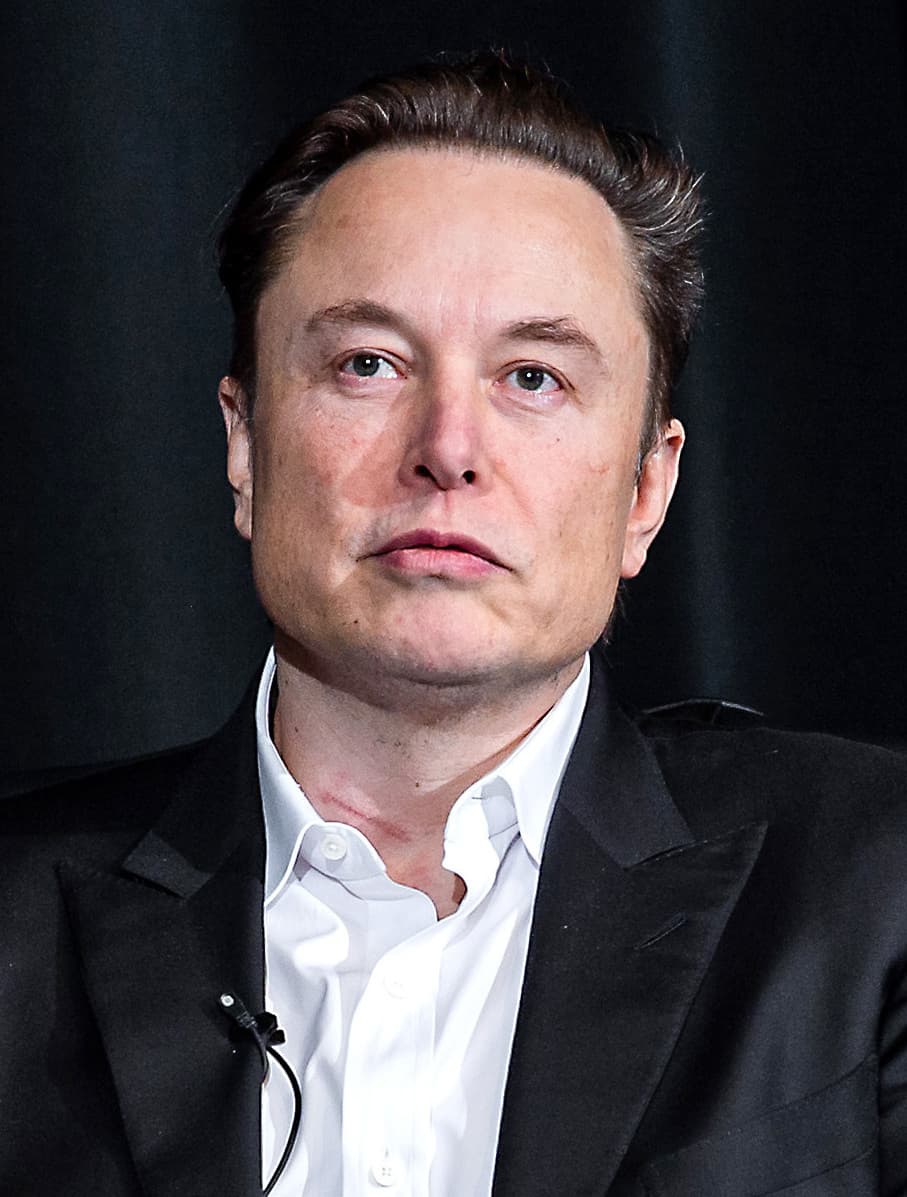
Portrait photograph of Elon Musk

Photo: U.S. Air Force / Trevor Cokley · Public domain

Media Accountability Research · Prediction Ledger

The Musk Ledger

A decade of confident, dated, falsifiable predictions from Elon Musk - about his own technologies, his companies, and the future of the economy - that missed their mark, slipped for years, or never happened at all. Each entry pairs the original claim with what actually came to pass, and links the documentation.

Compiled July 2026 · 46 entries · 5 categories

Showing 46 of 46 entries

Self-Driving & Robotaxi

10 entries

The most-repeated forecast in the ledger: a version of 'full self-driving next year' made almost every year since 2015, plus the robotaxi fleet and the 'appreciating asset' pitch.

Complete autonomy "in about two years"

Fortune interview

medium confidenceDec 21, 2015
[Tesla vehicles will be capable of complete autonomy in] a bit over two years.
The prediction
Full/complete self-driving by roughly 2018. (Fortune's headline: 'Tesla Vehicles Will Drive Themselves in Two Years.')
What actually happened
Not achieved. In 2026 Teslas still require a supervising driver; FSD remains SAE Level 2 driver-assistance.

Note: Paraphrase of an interview rather than a verbatim quote.

SourcesFortune

Coast-to-coast autonomous drive by end of 2017

Tesla hardware announcement

high confidenceOct 19, 2016
We'll be able to do a demonstration drive of full autonomy all the way from LA to New York … by the end of next year, without the need for a single touch, including the charger.
The prediction
A zero-intervention, LA-to-New-York self-driving demonstration by the end of 2017.
What actually happened
It never happened - not in 2017, and the promised no-human-touch coast-to-coast demo has still never been performed.

SourcesTechCrunch

All cars have the hardware; full autonomy by 2018 via software

Tesla official announcement

high confidenceOct 19, 2016
All Tesla vehicles produced in our factory … will have the hardware needed for full self-driving capability at a safety level substantially greater than that of a human driver.
The prediction
Cars built from 2016 (HW2) would become Level 4/5 self-driving through over-the-air software updates by 2018.
What actually happened
HW2/HW2.5 cars were never made fully self-driving. Tesla later conceded they needed hardware retrofits (HW3, then HW4), and by 2025 acknowledged even some HW3 cars may need upgrades. The software-only promise failed.

SourcesElectrek·NBC News

FSD "feature complete this year" (2019)

ARK Invest podcast

high confidenceFeb 19, 2019
I think we will be feature complete - full self-driving - this year.
The prediction
FSD feature-complete in 2019, with drivers able to 'fall asleep and wake up at their destination' by end of 2020.
What actually happened
FSD was not feature-complete in 2019, and sleeping in a moving Tesla is still neither legal nor supported. FSD remains driver-supervised.

SourcesCNBC

"Over a million robotaxis" by end of 2020

Tesla Autonomy Day

high confidenceApr 22, 2019
A year from now, we'll have over a million cars with full self-driving … operating robotaxis next year with no one in them.
The prediction
More than one million Tesla robotaxis operating driverless by the end of 2020.
What actually happened
Zero robotaxis operated in 2020. No robotaxi pilot began in any form until a narrow, supervised Austin rollout in mid-2025.

SourcesCNBC

A Tesla is an "appreciating asset"

Tesla Autonomy Day

high confidenceApr 23, 2019
If you buy a Tesla today, I believe you are buying an appreciating asset - not a depreciating asset. … It's financially insane to buy anything other than a Tesla.
The prediction
FSD would turn each Tesla into an income-generating robotaxi, making it appreciate in value.
What actually happened
With full autonomy never arriving, Teslas depreciated like normal cars; used-Tesla prices fell sharply in 2023–2024.

SourcesCNBC·Electrek (retrospective)

"Level 5 autonomy complete this year" (2020)

World AI Conference, Shanghai

high confidenceJul 9, 2020
I remain confident that we will have the basic functionality for Level 5 autonomy complete this year.
The prediction
Level 5 (no human needed, any conditions) essentially complete in 2020.
What actually happened
No Level 5 - or even consumer Level 3 - arrived in 2020 or since. Tesla's own filings to California regulators stated FSD would remain Level 2.

SourcesReuters

"We'll achieve Full Self-Driving this year" (2022)

Tesla Q4 2021 earnings call

high confidenceJan 26, 2022
My personal guess is that we'll achieve Full Self-Driving this year, [with safety] better than human.
The prediction
FSD solved, safer than a human, in 2022 - the same promise made in 2020 and 2021.
What actually happened
Not achieved in 2022. FSD Beta remained a supervised Level 2 system. Jalopnik noted it was 'next year' for the ninth year running.

Note: Worth a primary-transcript check for exact wording; substance well documented.

SourcesThe Verge

Dedicated robotaxi in volume production by 2024

Tesla Q1 2022 earnings call

high confidenceApr 20, 2022
[A dedicated robotaxi] highly optimized for autonomy … with no steering wheel or pedals … aiming for volume production in 2024.
The prediction
A purpose-built robotaxi mass-produced in 2024.
What actually happened
No robotaxi was mass-produced in 2024. The 'Cybercab' was only unveiled as a prototype in October 2024, with production pushed to 'before 2027.'

SourcesTechCrunch

Paid driverless robotaxis in Austin by June 2025

Tesla Q4 2024 earnings call

high confidenceJan 29, 2025
[A paid ride-hailing robotaxi service in Austin in June 2025 with] no drivers in the cars … unsupervised FSD to owners in many regions of the U.S. in 2025.
The prediction
Driverless paid robotaxis in Austin by June 2025, scaling to 8–10 metros and 'half the US population' by year-end; unsupervised FSD released to owners nationwide.
What actually happened
The June 2025 launch was geofenced, invite-only, ~10–20 vehicles, and - contradicting 'no drivers' - carried in-car safety monitors plus chase cars. Months later it was still ~20 vehicles in about two metros; unsupervised FSD was not broadly released.

Note: Prediction is verbatim/close; the rollout reality is drawn from detailed Electrek tracking.

SourcesTechCrunch·Electrek (status check)

Mars & SpaceX

11 entries

A continuously receding Mars horizon - 2021, then 2024, then 2026 - alongside cancelled Moon-tourism flights and Starship-to-orbit dates that slipped by years.

Humans on Mars "in 10 years" (by ~2021)

Wall Street Journal interview

medium confidence2011
[Humans on Mars in] as little as 10 years … worst case, 15 to 20 years.
The prediction
First humans on Mars possibly by 2021.
What actually happened
No human - and no SpaceX vehicle - has reached Mars. Missed by 5+ years and counting.

Note: Widely reported paraphrase of a 2011 interview; predates the 10-year window but sets the pattern.

SourcesNBC News

Crewed Mars flights by ~2024; million-person city

67th IAC, Guadalajara

high confidenceSep 27, 2016
[First crewed Mars flights potentially 2024; ~$200,000 a seat; ultimately a self-sustaining city of one million people.]
The prediction
Crewed Mars missions beginning ~2024, building toward a million-person Martian city.
What actually happened
No crewed or uncrewed SpaceX Mars flight has occurred; the vehicle (later Starship) has not reached orbit or Mars.

SourcesTIME·Space.com

"Red Dragon" uncrewed Mars landing in 2018

SpaceX announcement

high confidenceApr 2016
[An uncrewed Dragon capsule would soft-land on Mars as early as 2018.]
The prediction
A robotic Mars landing by 2018.
What actually happened
Never flew. Slipped to 2020, then cancelled when SpaceX dropped propulsive Dragon landings. Musk in 2017: 'I'm pretty confident that is not the right way [to land on Mars].'

SourcesSpaceNews

Two tourists around the Moon in 2018

SpaceX press call

high confidenceFeb 27, 2017
[Two private citizens who paid deposits would fly a week-long loop around the Moon before the end of 2018 on Falcon Heavy and Crew Dragon.]
The prediction
A crewed lunar-flyby tourism flight by late 2018.
What actually happened
Never happened; slipped to 'mid-2019 or later,' then was quietly dropped and folded into the (later cancelled) Starship dearMoon plan.

SourcesSpace.com

Cargo to Mars 2022, crew to Mars 2024

68th IAC, Adelaide

high confidenceSep 29, 2017
[First uncrewed cargo ships to Mars in 2022; two cargo plus two crew ships departing for Mars in 2024.]
The prediction
Uncrewed Mars landing in 2022; crewed Mars landing in 2024.
What actually happened
Neither occurred; no Starship has left Earth orbit.

SourcesSpace.com

"Anywhere on Earth in under an hour" by rocket

IAC Adelaide / Instagram

high confidenceSep 29, 2017
Fly to most places on Earth in under 30 mins and anywhere in under 60. Cost per seat should be about the same as full fare economy in an aircraft.
The prediction
Commercial point-to-point suborbital rocket passenger travel.
What actually happened
Never demonstrated with passengers; no commercial point-to-point service exists. Still purely conceptual.

SourcesDezeen

#dearMoon - Maezawa around the Moon by 2023

SpaceX event, Hawthorne

high confidenceSep 17, 2018
[Yusaku Maezawa and eight artists would fly a Starship loop around the Moon by the end of 2023.]
The prediction
A crewed Starship lunar flyby by end of 2023.
What actually happened
Cancelled June 2024 due to Starship delays; never flew. Maezawa: 'I can't plan my future in this situation.'

SourcesSpaceNews

Starship to orbit "in less than six months"

Starship update, Boca Chica

high confidenceSep 28, 2019
This is going to sound totally nuts, but I think we want to try to reach orbit in less than six months.
The prediction
First orbital Starship flight by roughly early-to-mid 2020.
What actually happened
The first integrated Starship flight came in April 2023 and exploded minutes in. As of late 2025 Starship still had not completed a full orbital insertion. Missed by 3+ years.

SourcesSpace.com

Humans on Mars by 2026 ("if we get lucky, 2024")

Axel Springer Award, Berlin

high confidenceDec 1, 2020
[Highly confident of landing humans on Mars] about six years from now. … If we get lucky, maybe four years.
The prediction
A crewed Mars landing in 2024–2026.
What actually happened
No SpaceX vehicle has reached Mars or even trans-Mars injection. The 2024 window passed with no launch; a 2026 crewed landing is not happening.

SourcesCNBC

Starship crewed Moon landing (Artemis 3) by 2024

NASA HLS contract / SpaceX

high confidenceApr 2021
[SpaceX's Starship Human Landing System would land NASA astronauts on the Moon for Artemis 3, targeted for 2024.]
The prediction
A crewed lunar landing in 2024 (later slipped to Dec 2025).
What actually happened
The GAO (Nov 2023) found a landing 'unlikely before 2027'; a Nov 2025 internal SpaceX document reportedly put the earliest crewed attempt at September 2028, with orbital refueling not demonstrated until 2026.

SourcesSpace.com (GAO)·Space.com (2028 report)

One million people on Mars by 2050

Twitter

medium confidenceJan 16–17, 2020
[~100 Starships a year, a fleet of 1,000 ships carrying ~100,000 people per window, to reach one million people on Mars by 2050. Asked to confirm: 'Yes.']
The prediction
A self-sustaining, million-person Martian city by 2050.
What actually happened
Zero people on Mars; launch cadence and orbital refueling are orders of magnitude short of what the plan requires.

Note: Long-range target not yet formally due - included because the near-term steps have already slipped badly.

SourcesFuturism

Tesla Products & Production

11 entries

Vehicles and products promised at prices, dates, and volumes that reality didn't meet - Roadster, Semi, Cybertruck, the $35k Model 3, Solar Roof, and battery swap.

Next-gen Roadster - "available 2020"

Roadster unveiling

high confidenceNov 16, 2017
[The fastest production car ever made - 0–60 in 1.9s, 620+ mile range, $200,000 - production in 2020;] later, a 'SpaceX package' with cold-gas thrusters that could let it briefly hover.
The prediction
Roadster in production by 2020, later hyped as able to nearly 'fly.'
What actually happened
Still not in production ~9 years later, despite $50,000 reservation deposits taken since 2017. The 'flying' demo has been pushed at least eight times.

SourcesTechCrunch·TechRadar

Tesla Semi - "production 2019"

Semi unveiling

high confidenceNov 2017
[500-mile range, production starting 2019.]
The prediction
Volume production of the electric Semi truck beginning in 2019.
What actually happened
Only a handful of pilot units reached PepsiCo in December 2022; high-volume production did not begin until 2026 - roughly seven years late.

SourcesElectrek·TechCrunch

Cybertruck - "$39,900" base price

Cybertruck unveiling

high confidenceNov 21, 2019
[Single-motor RWD $39,900; dual-motor $49,900; tri-motor $69,900 - cheaper models in late 2021.]
The prediction
A $39,900 base Cybertruck, on sale from late 2021.
What actually happened
Production didn't start until late 2023; real prices ran ~$100,000–$120,000. The $39,900 model never appeared, and the cheap RWD preorder option was pulled.

SourcesCNBC·Yahoo/AOL

Cybertruck - "250,000–500,000 per year"

Tesla comments / Q4 2022 call

high confidence2022–2023
[Cybertruck could eventually sell 250,000–500,000 units per year.]
The prediction
Annual Cybertruck sales of a quarter- to half-million.
What actually happened
Roughly ~40,000 sold in full-year 2024 - a fraction of even the low-end target - with sales falling further in 2025–2026.

SourcesInsideEVs·Electrive

Model 3 - "5,000 a week by December 2017"

2017 guidance

high confidence2017
[5,000 Model 3s per week by December 2017.]
The prediction
A 5,000/week Model 3 production rate by end of 2017.
What actually happened
Only ~2,425 were built in all of Q4 2017; the 5,000/week rate wasn't hit until the end of June 2018 - about six months late, via a tent-based line.

SourcesNPR·TechCrunch

"20 million vehicles a year by 2030"

Tesla Impact Report / shareholder meeting

high confidence2021–2022
[An aspiration of 20 million vehicles per year by 2030.]
The prediction
20 million Teslas produced annually by 2030.
What actually happened
Tesla delivered ~1.79M in 2024 - roughly an order of magnitude short. Tesla quietly removed the 20-million goal from its impact report in May 2024.

SourcesReuters via US News

"50% average annual growth" in deliveries

Tesla guidance (2021–2022)

high confidence2021–2022
[~50% average annual growth in vehicle deliveries over a multi-year horizon.]
The prediction
Sustained ~50% yearly delivery growth.
What actually happened
2024 deliveries fell ~1.1% - Tesla's first annual decline since 2011 - and sales fell again into 2026, nowhere near 50% growth.

SourcesPBS/AP

Solar Roof - cheaper than a normal roof, 1,000/week

Unveiling / 2019 relaunch

high confidence2016–2019
[The Solar Roof would cost less than a conventional roof plus the electricity it generates; target of 1,000 installations per week by end of 2019.]
The prediction
A cheaper-than-normal solar roof installed at 1,000 per week.
What actually happened
Peak deployment (2022) was only ~23 roofs per week - ~97.7% short. Prices ballooned (one quote jumped $72k→$146k), a class action followed, and Tesla stopped reporting Solar Roof numbers and pivoted back to panels.

SourcesElectrek·TechCrunch

Battery-swap stations - "faster than a gas fill"

Live demo

high confidenceJun 2013
[A Model S battery swapped in ~90 seconds, 'faster than you could fill a gas tank,' with swap stations planned along highways.]
The prediction
A network of battery-swap stations as an alternative to charging.
What actually happened
Of ~200 invited owners, only a handful ever used the pilot. Musk in 2015: 'People don't care about pack swap.' The program was abandoned; the network never materialized.

SourcesFortune

The "$35,000 Model 3"

Model 3 reveal

high confidenceMar 2016
[A $35,000 base Model 3.]
The prediction
A genuinely $35,000 mass-market Tesla.
What actually happened
The $35,000 version only appeared in Feb 2019, sold off-menu, made by software-limiting a pricier car; it was pulled within weeks and discontinued with the 2021 refresh. It never returned at that price.

SourcesGreen Car Reports·CNN

Model S "Plaid+" - 520+ mile range

2020 announcement / 2021 order page

high confidence2020–2021
[A Model S Plaid+ with 520+ miles of range, ~$130k, slated for 2021.]
The prediction
A 520-mile flagship Model S.
What actually happened
Musk cancelled it in June 2021 - 'Plaid+ is canceled. No need, as Plaid is just so good' - before a single delivery. The shipped Plaid tops out around 390–405 miles.

SourcesCNBC

Economy, AI & X

7 entries

COVID, recession-timing, AI timelines, and the Twitter/X business projections - forecasts about the wider world rather than a single machine.

"The coronavirus panic is dumb"

Twitter

high confidenceMar 6, 2020
The coronavirus panic is dumb.
The prediction
That pandemic concern was overblown.
What actually happened
COVID killed ~1.1M+ Americans and ~7M globally and triggered the largest economic shock since the Depression.

SourcesForbes (timeline)

"Close to zero new cases by end of April"

Twitter

high confidenceMar 19, 2020
Based on current trends, probably close to zero new cases in US too by end of April.
The prediction
U.S. COVID cases falling to ~zero by end of April 2020.
What actually happened
The U.S. was recording 20,000–30,000+ new cases per day in late April 2020, with 1M+ cumulative cases and 60,000+ deaths by month's end. Off by an enormous margin.

SourcesForbes·Musk tweet

U.S. recession "probably ~18 months"

Remarks / Twitter

high confidenceMay 16, 2022
[The U.S. is 'probably' already in a recession that will last up to ~18 months.]
The prediction
A U.S. recession running into 2023.
What actually happened
No U.S. recession materialized; GDP grew ~2.5% in 2023 and unemployment stayed near historic lows.

SourcesFortune

Global recession "until the spring of 2024"

Tesla Q3 2022 earnings call

high confidenceOct 21, 2022
[A global recession lasting 'probably until spring of 2024.']
The prediction
A global recession persisting into spring 2024.
What actually happened
No U.S. recession arrived through spring 2024; markets hit record highs and growth continued.

SourcesCNBC

"AI smarter than any one human" by end of 2025

Livestream with Nicolai Tangen (X)

medium confidenceApr 9, 2024
My guess is that we'll have AI that is smarter than any one human probably around the end of next year.
The prediction
AI smarter than the smartest human by the end of 2025 (and smarter than all humans combined within ~5 years).
What actually happened
As of 2026 there is no consensus that any AI is 'smarter than any one human' across domains; the stated deadline is widely regarded as unmet.

Note: Inherently contestable to adjudicate, but the deadline as phrased was not credibly met.

SourcesFortune

Twitter/X - $26.4B revenue & 931M users by 2028

Investor pitch deck

high confidenceMay 2022
[Projected growing revenue ~5x to $26.4B by 2028, ~931M users by 2028, and 69M Twitter Blue subscribers by 2025.]
The prediction
Explosive revenue, user, and subscription growth after the acquisition.
What actually happened
X ad revenue collapsed to roughly $2.5B in 2023 (about half of 2021); Blue/Premium subscribers are in the low millions, not 69M; the company has been valued far below the $44B purchase price.

SourcesThe Next Web·Fortune

Tesla will accept Bitcoin for cars

SEC filing / tweets

medium confidenceFeb 2021
[Tesla bought $1.5B in Bitcoin and would accept it as payment for vehicles.]
The prediction
Bitcoin as an ongoing payment option for Teslas.
What actually happened
Tesla suspended Bitcoin payments about three months later (May 2021), citing environmental concerns - a rapid reversal.

Note: A reversed commitment rather than a dated forecast; included for completeness.

SourcesReuters